ב״ה
For parents
The DMB Card,
explained.
Davening. Middos. Brachos. The DMB Card turns the things that matter most at home into something your child can see, count and be proud of — with you as the one who confirms it, and a Rebbe on the other end who reviews every step.
Interested?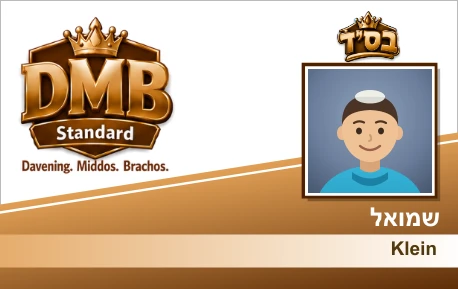
Card 1 of 14Standard
The idea
Children grow when growth is noticed. At school a Rebbe can see a boy daven; at home, the person who sees it is you. The DMB Card is built around that: your child earns points for real things — davening with kavana, a bracha said out loud, being kind to a brother — and you are the witness who says it happened.
Points build up all year and never expire. They turn into real prizes. And as your child grows, he moves up a ladder of fourteen beautifully printed DMB cards — each one adding a bigger bonus to every point he earns from then on. It is a long, steady climb, designed to keep a child motivated not for a week but for years.
How it works
- 1
Your child gets his card and his own login
Every child receives a printed DMB card with a personal QR code. Scanning it opens his own page, where he sees his points, his card, and how close he is to the next one. You get a separate parent login of your own.
- 2
You choose what he works on
From a library of check-in questions — davening, brachos, middos, helping at home, bedtime and more — you pick the ones that fit your child, and how often they come up: daily, weekly, every two weeks or monthly. You can even write your own, which the Rebbe reviews and prices.
- 3
He answers, you confirm
Your child answers his check-ins on his own page. Nothing counts until you confirm it — you can confirm, say it was only partly right, or say you don't agree. He never sees what you answered. You get a short email reminder when answers are waiting, never more than one a day.
- 4
The Rebbe reviews, and the week is paid
Everything you confirm goes to the Rebbe, who approves it. Points and zones are paid together once a week, before Shabbos. A standard week is capped so the points keep their value — and you can raise your child's weekly target if he needs a bigger goal.
- 5
Zones fill, and the next card opens
Each card has a number of zones to fill. When they are full, your child can apply for the next card. He answers questions about his davening, brachos and behavior at home; you read what he wrote and sign it; the Rebbe approves — and a new card is his.
- 6
Points become prizes
Points turn into real prizes, chosen from a prize list your child can browse. The higher his card, the bigger the prize he can reach for.
More ways to earn
Pesukim & Rashi
Your child records himself reading pesukim and Rashi right from his phone or tablet. The Rebbe listens to every recording and awards points.
Kriah
Reading practice, recorded and reviewed the same way — the Rebbe hears him read and encourages him along.
Friendship
Having a friend over for a playdate or Shabbos, or going to a friend, earns points. You confirm it; the Rebbe approves it.
From you
You can give your child up to three points a day yourself, for anything you see — straight from your parent page. Watch his face when the balloons go up.
The fourteen cards
Every child starts on Standard. Each card above it adds a bonus to every point earned while holding it — so a child on Gold who earns 100 points gets 4 more on top, and a child on Royal gets 75 more. The higher cards also take more zones to fill, so each step up means something.
#1
Standard
+0%
5 zones
#2
Silver
+2%
10 zones
#3
Gold
+4%
15 zones
#4
Ruby
+7%
20 zones
#5
Diamond
+10%
25 zones
#6
Platinum
+15%
30 zones
#7
Premium
+20%
35 zones
#8
Signature
+25%
40 zones
#9
Classified
+30%
50 zones
#10
Obsidian
+35%
60 zones
#11
Legendary
+40%
70 zones
#12
Sapphire
+50%
80 zones
#13
VIP
+60%
90 zones
#14
Royal
+75%
100 zones
Questions parents ask
- How much time does it take?
- A few minutes a day for your child, and a few minutes a few times a week for you to confirm his answers. Everything works from a phone.
- Does it matter which school my child goes to?
- No. The DMB Card happens at home, alongside whatever school your child attends.
- Who sees what my child writes, and what I answer?
- Only you and the Rebbe. Your child never sees your answers, and nothing he writes is shown to anyone else.
- Can grandparents follow along?
- Yes. You can invite a grandparent from your parent page. They see your child's points and card — the nachas — without the confirming.
- What does it cost?
- We'll go over the details with you personally once you send in your information.
- What happens after I sign up?
- Your information comes to the Rebbe, who reviews it and gets in touch. Once your child is added, you receive an email with a link to set up your parent login, and your child's card is printed.
Ready to start?
Tell us about your family. It takes about five minutes, and nothing is charged or committed — the Rebbe will be in touch with you first.
Create an accountAlready have a login? Sign in